
 By
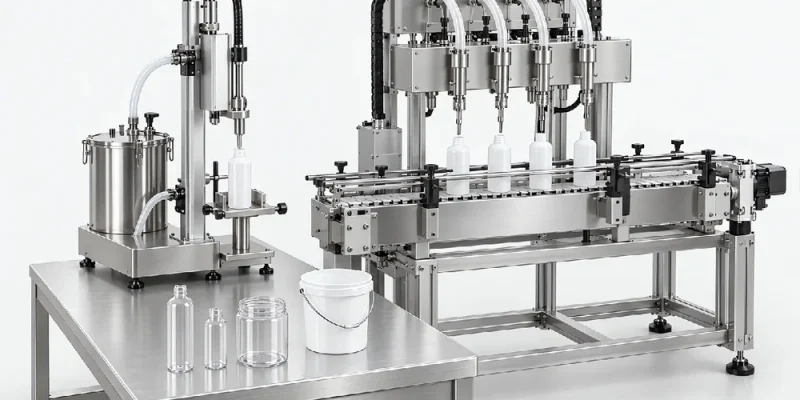
Three quotations lie on the desk. Each describes a machine that fills the same container with the same product, and the totals differ by a margin wide enough to make the cheapest look irresistible. Anyone buying filling equipment singapore reaches this moment. The prices cannot be compared until the documents are, line by line, because suppliers rarely quote the same thing. What follows is a way of reading the three side by side.
Line One: What Is Actually Being Filled
Start by checking that each supplier has understood the task. Look for the product named with its viscosity or a description of how it pours, its temperature, whether it foams or is flammable, and every container size. If one quotation says only ‘liquid, 1 to 5 litres’, its price rests on assumptions, and the difference will reappear later as a variation order. Send all three bidders the same written brief and samples before treating their figures as comparable.
Line Two: How the Dose Is Measured
One bidder may offer a piston filler, another a flow meter system, the third a weigh-scale machine. These are not interchangeable. Piston and meter systems measure volume and are compact and quick. Scale-based systems measure mass and are unaffected by density drift. Ask each to state the expected fill tolerance on your product and container, and how it will be proved. A cheaper method that overfills slightly on every pack can cost more in giveaway than it saved.
Line Three: Level of Automation
Read carefully what the operator is expected to do. A semi-automatic machine may need someone to place each container and press start. An automatic one indexes containers itself. Between the two lie many variants. Count the people each proposal needs per shift and price them honestly, including the difficulty of filling repetitive posts. The dearest quotation sometimes describes a line that runs with one person where the cheapest needs three.
Line Four: What Is Missing
Now look for absences. Is the infeed conveyor included, or only the filling head? The product pump and supply hose? Drip trays, guarding, a control panel with stored recipes? Change parts for the second and third container sizes? Suppliers of filling machinery for local production lines generally itemise these, and where an item is absent it should be queried, not assumed. Build a single table with every element down the side and the three bidders across the top.
Line Five: Materials and Hazard Rating
Contact parts in the right grade of stainless steel, seals compatible with the product, and a frame finish suited to washdown all add cost for good reason. If the product is flammable, the machine must be built for a hazardous area, with certified explosion-protected components and earthing provisions. A quotation that omits this for a solvent is not cheaper; it is for a different, unusable machine. Confirm the zone classification with your safety officer first.
Line Six: Output, Stated Honestly
Speed figures deserve suspicion. Ask whether the number quoted is containers per minute on water or on your product, at which size, and whether it includes the time containers take to enter and leave. Then ask what the rest of your line can handle. A filler twice as fast as the capper behind it delivers no extra output. The useful figure is sustained packs per hour over a shift, allowing for changeovers and cleaning.
Line Seven: Delivery, Installation and Training
Check the delivery term: ex-works overseas, or delivered and positioned on your floor? Who pays freight, insurance and duties, and who arranges rigging to an upper-storey unit? Is installation by the supplier’s own engineer included, for how many days? Is operator and maintenance training part of the price? A quotation that stops at the factory gate abroad leaves a long list of costs, and risks, on the buyer’s side of the table.
Line Eight: Service Within Reach
A filler is a long-lived asset with seals that last months. Ask each bidder where its technicians are based, what response time it commits to, and which spares are held locally. Request the recommended spares list with prices and add it to the comparison. Ask who holds the controller program and whether you receive a copy. An overseas vendor with no local partner may be excellent, but downtime while a part clears customs has to be priced in.
Line Nine: Proof Before Payment
Finally, compare what each supplier will demonstrate and when money changes hands. A factory acceptance test on your product before shipment, a site acceptance test after installation, and a retention held until the second is passed are standard protections. Look at warranty length and what it excludes. Ask for two customers running similar products whom you may telephone. Reluctance on any of these points tells you more than the brochure.
Reading the Total Again
With the table complete, add the missing items to each bid at realistic prices, then add labour per shift, likely giveaway and a view of service risk over ten years. The ranking often changes. Choose the offer that meets the brief in full, proves its performance on your product and can be supported nearby. Bought on that basis, filling equipment singapore becomes a predictable part of the line, and the cheapest sheet of paper stops looking like a bargain.










Comments